
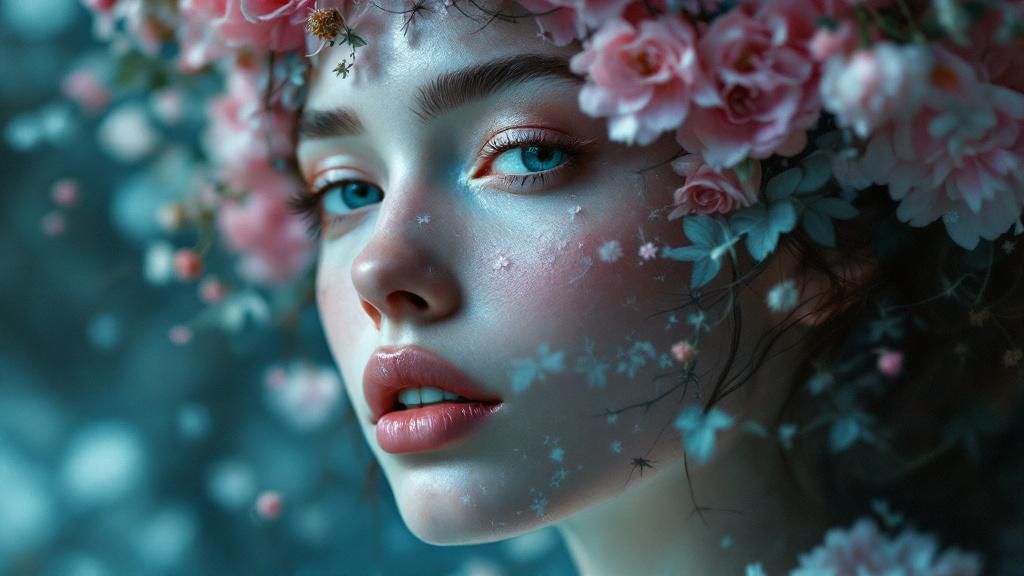
For 40 years, Dutch photographic artists Inez van Lamsweerde and Vinoodh Matadin have fundamentally reshaped the pictorial vocabulary of contemporary photography. The celebrated duo have built a formidable body of work that effortlessly combines art, fashion and portraiture, questioning the medium’s fundamental premise: that the camera never lies. Now, a significant retrospective show and accompanying publication, Can Love Be a Photograph: 40 Years of Inez and Vinoodh, documents their remarkable career through thoughtfully selected themes that illuminate the theoretical foundations of their practice. Running at Kunstmuseum Den Haag until 6 September, the exhibition showcases how the pair have consistently disrupted photography’s claim to documentary truth, reimagining their subjects through enhancement rather than disclosure.
The Dutch Masters Who Questioned The Truth of Photography
Throughout their four-decade body of work, Inez and Vinoodh have consistently questioned photography’s fundamental claim to authenticity. Their images stretch believability to its extreme boundaries, compelling viewers to reconsider not merely what they see, but their own willingness to accept the photograph as proof of reality. This conceptual rigour distinguishes their work from conventional portraiture, establishing photography itself as a disputed domain where truth and artifice collide. By using the camera as a tool for transformation rather than straightforward recording, they have fundamentally altered how contemporary photographers approach their subjects and how audiences consume visual information in an increasingly image-saturated world.
What defines Inez and Vinoodh distinctly is their distinctive approach to portraiture, wherein subjects are not made relatable through exposure but rather magnified through exaggeration. Whether photographing Brad Pitt at his most ethereal or Bill Murray with flowers threaded through his beard, they present their subjects with exceptional care, dignity and care. Their practice rejects the documentary approach entirely, instead treating each portrait as an means of reimagining identity itself. This approach has proven strikingly uniform across decades, from their initial projects in Face magazine during the nineties to their latest examinations of notable individuals as mythic presences and deities.
- Pioneering digital manipulation techniques that question photographic authenticity
- Integrating classic avant-garde methods including photomontage and collage
- Collaborating with stylists, makeup artists, and graphic designers seamlessly
- Using photographs as platforms for collective creative intervention
Beyond Documentation: Photography as Transformation
Intensification Instead of Explanation
Inez and Vinoodh’s groundbreaking approach fundamentally rejects the notion that photography uncovers authenticity through exposure. Rather than removing superficial elements to expose some core human truth, they deploy intensification as their main approach. Their subjects are heightened, enlarged and reconceived through precise aesthetic choices, imaginative light work and artistic constructs that regard portraiture as an art form rather than straightforward recording. This approach reshapes the medium from a medium of revelation into one of artistic remaking, where selfhood turns changeable and open to artistic interpretation. The result is portraiture that surpasses simple resemblance.
This dedication to amplification manifests most powerfully in their portrayal of public personalities and cultural icons. Brad Pitt emerges ethereal and vulnerable; Bill Murray appears thoughtful with plant life framing his face; Drew Barrymore is captured with an intensity that surpasses traditional portrait work. These portraits refuse easy categorisation, existing instead in a undefined realm between individuality and projection. The subjects remain recognisable yet fundamentally altered, reimagined through Inez and Vinoodh’s joint creative approach into something altogether more complex and visually arresting than conventional celebrity portraiture typically achieves.
At the heart of this transformative practice is the collaborative process that encompasses each shoot. Photographers, stylists, makeup artists, hairdressers, lighting technicians, graphic designers and editors come together to produce cohesive concepts that exceed any single creative perspective. Inez and Vinoodh intentionally present their photographs as canvases—even as cadavre exquis—inviting others to intervene and contribute. This multimedia layering, accomplished via both digital manipulation and traditional techniques like photomontage and collage, produces images that are intentionally crafted, undeniably artificial and genuinely transparent about their own artificiality.
- Subjects positioned as icons, deities and spectres suspended between reality and projection
- Styling and makeup function as sculptural forms transforming facial features
- Lighting design produces three-dimensional space that defies photographic flatness
- Joint creative efforts layer multiple creative perspectives into unified photographs
- Photographs operate as disputed territories between individuality and creative expression
The Shared Canvas: Art, Fashion and Surrealist Movement
For four decades, Inez and Vinoodh have operated at the intersection of photography, fashion and fine art, establishing a distinctive visual language that challenges conventional genre boundaries. Their work intentionally obscures the lines between documentary work and constructed fantasy, approaching each photograph as a shared creative work rather than a straightforward documentation of reality. This approach has positioned them as trailblazers within present-day visual arts, influencing generations of photographers, stylists, and creative directors. Their subjects—whether celebrated personalities or exquisite botanical specimens—are transformed beyond their established frameworks into something altogether more theatrical and conceptually rich.
The studio environment encompassing Inez and Vinoodh functions as a artistic collaborative space where various creative fields converge and interact. Photographers, stylists, makeup artists, hairdressers, lighting technicians and graphic designers collaborate closely, each providing specialised expertise to the end result. This deliberately orchestrated collaboration reflects the artistic method of cadavre exquis, where artists contribute sequentially without viewing previous contributions. By positioning their images as open canvases welcoming creative input, Inez and Vinoodh broaden access to the artistic practice whilst preserving a unified creative direction that brings together varied artistic viewpoints into individual, striking photographs.
Modern Technology Meets Established Methods
Whilst Inez and Vinoodh are internationally recognised for establishing digital alteration techniques in photography, their practice steadily embraces classical modernist approaches including photomontage and collage. This deliberate combination of current and historical methods creates intricate, layered works that underscore photography’s constructed nature. Rather than seeking to hide creative manipulation, they highlight it, making the act of making openly evident within the final artwork. This overt multimedia strategy distinguishes their work from photography that preserves illusions of unmediated truth-telling.
The synthesis of conventional and modern digital approaches demonstrates a refined grasp of photography’s history and current possibilities. By utilising approaches linked to early 20th-century avant-garde movements in conjunction with cutting-edge digital instruments, Inez and Vinoodh situate their work within broader art historical dialogues. This hybrid methodology enables remarkable control over all visual elements, from skin texture and colour depth to compositional arrangement and spatial organisation. The resulting photographs exist as consciously constructed creations that paradoxically express deep truths about identity, how we represent ourselves, and the nature of photographic perception itself.
- Photomontage and collage construct intricate visual stories in single frames
- Digital manipulation extends artistic control over photographic representation
- Explicit layering recognises photography’s constructed and interpretive nature
- Combined approaches connect modernist traditions and contemporary technological possibilities
Love as a Practice: The Newest Chapter
The forthcoming publication “Can Love Be a Photograph: 40 Years of Inez and Vinoodh” marks a major achievement in the Dutch duo’s illustrious career, providing a comprehensive retrospective of 40 years spent challenging photography’s core principles. Rather than offering a chronological survey, the artists have curated their extensive collection through 16 thematic structures that reveal surprising connections and persistent themes across their oeuvre. This thematic approach allows viewers to follow the development of their artistic vision whilst acknowledging the sustained analytical depth that has defined their practice since the 1980s. The related show at Kunstmuseum Den Haag offers a physical manifestation of these ideas, encouraging visitors to experience the transformative power of their imagery firsthand.
Love, in the context of Inez and Vinoodh’s practice, operates not as sentimental emotion but as a intentional approach—a commitment to treating subjects with deep compassion, dignity and care. This philosophical stance distinguishes their portraiture from more exploitative approaches to celebrity and documentation of culture. By approaching each subject with authentic regard and creative attentiveness, they transcend the superficial demands of commercial image-making. Their willingness to invest emotional and intellectual effort into every image elevates portraiture to the status of fine art. The retrospective demonstrates how this core principle of care has maintained their artistic endeavour through technological shifts, evolving fashion cycles and evolving cultural conversations about identity and representation.
| Series Theme | Artistic Vision |
|---|---|
| Still Life | Cultural figures and botanical subjects elevated to iconic, deity-like status through monumental scale and ethereal presentation |
| Worship | Subjects reconstituted as spectral presences suspended between individual identity and collective projection |
| Post Power | Male subjects portrayed with softness and vulnerability, challenging conventional masculinity through ornamental presentation |
| New Gods | Contemporary figures transformed into contemporary deities, interrogating celebrity culture and modern mythmaking |
The exhibition and publication represent not conclusions but openings—chances for audiences to interact with photography’s lasting ability to disclose, hide and reshape simultaneously. By documenting 40 years of creative development, Inez and Vinoodh illustrate that photography stays an remarkably significant vehicle for exploring selfhood, depiction and the blurred distinction between authenticity and fabrication. Their work keeps motivating emerging photographers and visual artists to challenge received wisdom about what images can reveal and what remains hidden. This retrospective guarantees their groundbreaking work will influence creative work for years ahead.
The Enduring Impact and Evolution of Visual Culture
Four decades of relentless innovation have positioned Inez and Vinoodh as shapers of modern visual expression. Their influence reaches well past the fashion and portrait photography worlds, permeating contemporary art spaces, curatorial practices and critical discourse surrounding representation itself. By systematically dismantling photography’s pretence to impartial documentation, they have profoundly changed how we interpret images in an era marked by image manipulation and synthetic media. Their legacy offers a essential lens for comprehending image literacy in the twenty-first century, where the boundaries between documentary and constructed imagery have become increasingly blurred and disputed.
As rising artists navigate an unprecedented technological landscape, Inez and Vinoodh’s methodological approach—merging conventional practices with cutting-edge digital innovation—offers an essential roadmap. Their conviction that photography serves as transformation rather than revelation resonates profoundly with contemporary concerns about authenticity and representation. The retrospective signals not an finishing point but a stimulus for continued inquiry, showing that photography’s capacity to question, challenge and reimagine continues to be as crucial and indispensable as always. Their practice ultimately establishes that visual art possesses the power to transform collective awareness and examine our core convictions about identity and truth.
